Platform
One loop. Four stages.
A gate before every claim.
ITAS is not a dashboard you have to remember to open. It is a state machine that walks each patient through enrollment, monitoring, clinical review, documentation, and billing — stopping and waiting whenever a decision needs a licensed human, and refusing to advance when a billing requirement is unmet.
Nothing about how you practice has to change
The workflow
From eligible patient to defensible claim
Six steps, in order, every month. Steps that require a license are held for one. Steps that don't, run themselves.
- 01
Identify who qualifies
We read your panel through a standard FHIR export and match problem lists against the chronic-condition criteria for each program. You get counts and names, not a marketing list.
Reads your chart. Writes nothing yet.
- 02
Draft the order
The order is drafted with the qualifying diagnoses attached and the program-specific requirements pre-checked, ready for a signature. It is a draft until a clinician makes it real.
AI drafts. It never signs.
- 03
A clinician signs
Your physician or NP reviews and signs. Nothing ships, nothing enrolls, and nothing bills before that signature exists in the record with a timestamp.
Hard gate #1.
- 04
Capture consent
Verbal or written, program-specific, dated, and documented — including the cost-sharing disclosure, the single-biller rule, and the patient's right to stop at any time.
Hard gate #2.
- 05
Device and readings
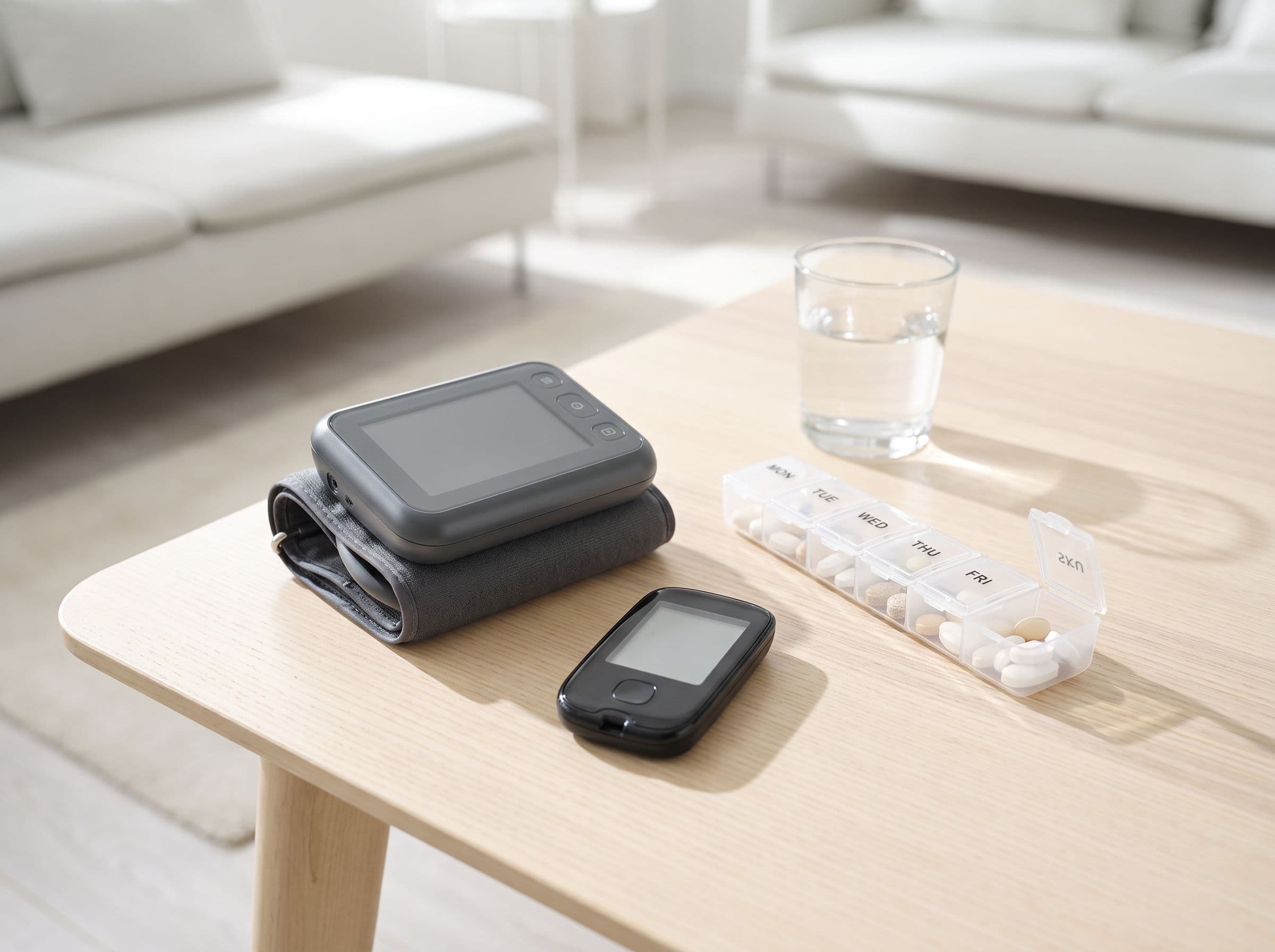
For RPM, a device ships preconfigured to the patient and transmits on its own cellular connection. Distinct transmission days accumulate against the 2–15 and 16–30 day thresholds.
Manual entries are engagement, never billable data.
- 06
Document, gate, bill
Notes, time logs, and the interactive-communication record are assembled as the work happens. Months that clear every gate are prepared as claims. Months that don't are held.
Hard gate #3.
Where the software stops
AI drafts. Humans decide. That line is enforced in code.
The interesting question about clinical AI is not what it can do, it is what it is permitted to do. Ours is permitted to read, rank, and draft. It is not permitted to release anything to a patient, a chart, or a payer.
Every action that touches a patient, a chart, or a claim has a named human attached to it, with a timestamp.
The engine does
- Scan the panel for program eligibility
- Draft orders, outreach, and clinical notes
- Triage incoming readings by acuity
- Count distinct transmission days
- Assemble time logs and evidence files
- Prepare claims and check for double-dips
The engine never
- Signs an order or a note
- Makes a diagnosis or changes a plan
- Adjusts or prescribes medication
- Enrolls a patient without documented consent
- Submits a claim to any payer
- Sees a patient's name, date of birth, or MBI
What the model actually receives
Inputs are minimized before they leave our boundary: an opaque internal token, an age, coded conditions, and the readings themselves. No name, no date of birth, no Medicare Beneficiary Identifier, no address. Model access runs under a signed business associate agreement on HIPAA-eligible surfaces only.
Our security posture, stated plainlyWhat your team sees
One queue, sorted by who needs attention first
Not a dashboard of charts. One decision at a time, carrying the reading that triggered it, the patient's context, and the action that resolves it. The billing rationale is there when you want it, folded away when you don't.
The live console. Every patient name, reading, and count shown is synthetic.
The care ladder
Why monitoring is the wedge
Monitoring is the bottom rung, and almost every chronic patient can stand on it. Each rung above it is more care actually delivered — and more of that care becoming billable.
- 1Rung 1
MonitoringThe wedge
Device data shows what happens between visits, counted automatically in distinct transmission days. This is the rung every chronic patient can climb onto.
99453 setup99454 · 16–30 days99445 · 2–15 days - 2Rung 2
InsightThe engine
Readings become a ranked list of who needs attention and why, with the outreach and the note drafted before anyone opens a chart.
No standalone code. This is the layer that turns monitoring into billable care instead of a data lake nobody reads.
- 3Rung 3
CareYour clinicians
The provider reviews, decides, orders, and signs — including the live interactive communication that CMS requires before management time can be billed.
99457 · 99458G0556–G055899490 · 99439 - 4Rung 4
RevenueIt compounds
Recurring monthly programs that stack per patient. APCM and CCM are Medicare; RPM is also widely reimbursed by commercial plans and Medicare Advantage.
Recurring monthlyStacks per patient
Codes shown are the families ITAS supports end to end. Whether any individual patient-month is billable depends on documented eligibility, consent, transmission days, clinical time, and payer coverage.
Go deeper
The three programs, rule by rule


See what's already sitting in your panel
A 30-minute scan on your own numbers: who qualifies today, and what the monthly line looks like next to our fee.
No EHR change. No commitment.